
Key takeaways
Define who the Cleric helps and what they feel now before choosing sacred-looking clothing or effects.
Translate values into two or three materials, one controlled palette, and visible signs of use or care.
Choose armor for the character’s current work, then keep the face and posture more important than protection.
Create one original symbol from a simple idea, shape, material, placement, and condition instead of copying official marks.
Review the result at thumbnail size and correct one failed visual category at a time.
Start D&D cleric character design with the person
Begin with a person rather than a class label. Choose an age range, face shape, grooming choice, complexion, and one memorable feature such as a weathered brow, careful braid, crooked smile, or small scar. Then name the emotion visible in this moment: patient attention, protective resolve, exhausted compassion, private doubt, cautious hope, or restrained anger. The face should still communicate that emotion after every symbol, garment, and effect is removed.
Next, describe the character’s relationship to faith in one practical sentence. They might keep a roadside shrine, guide frightened travelers, tend wounds after a battle, preserve community records, challenge a harmful tradition, or protect a place that matters to them. This sentence is not a biography or doctrine. It is a decision filter: details that support the current service stay, while details that only make the portrait look generically sacred can be removed.
Use posture to connect inner belief with visible behavior. A listener may lower the shoulders and meet the viewer with an even gaze; a vigilant guide may angle one shoulder toward the road; a doubtful devotee may hold a pendant without looking at it; and a tired healer may stand upright despite visible fatigue. None of these options defines every Cleric. They create a specific individual whose faith can be read without relying on a rulebook.
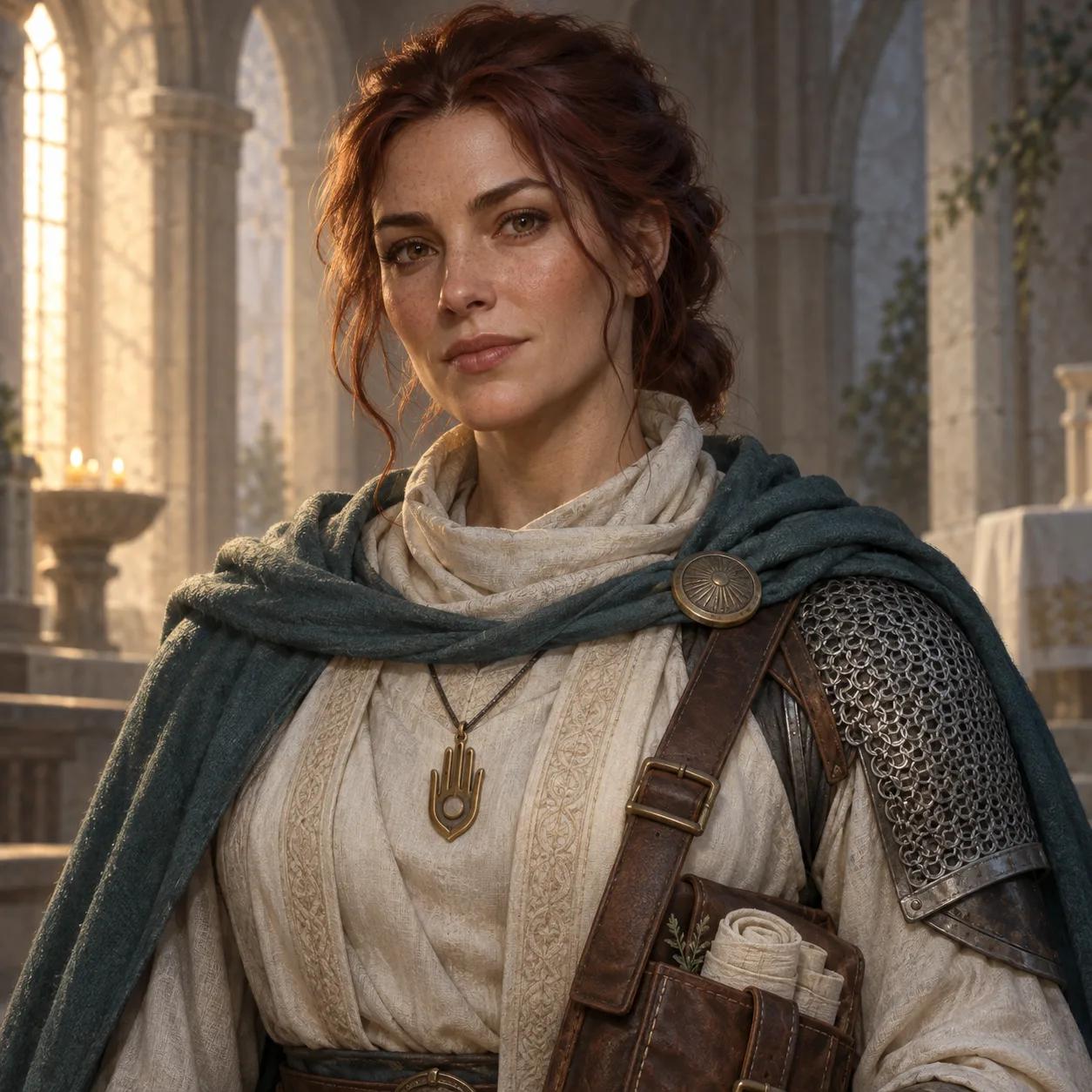
- Person: define face, age, grooming, expression, and one memorable feature.
- Service: choose one responsibility that affects the character’s present appearance.
- Tension: decide whether belief feels settled, tested, hopeful, protective, or uncertain in this moment.
Turn a form of service into visual priorities
Different forms of service need different visual evidence. A community healer can emphasize clean hands, repaired cloth, a bandage roll, and a warm but alert expression. A traveling protector may need weathered outer layers, one controlled armor zone, a compact tool or weapon, and a posture that watches beyond the frame. A keeper of records can use a book edge, ink-stained fingers, a small key, or a carefully maintained clasp while keeping the shoulders quieter.
Choose one primary cue and one supporting cue. For a healer, the primary cue might be the face and the supporting cue a bandage satchel. For a shrine keeper, the primary cue might be a calm hand near an original pendant and the supporting cue a worn key. For a martial Cleric, the primary cue can remain the steady face while a mail shoulder and lowered hammer explain protection. When three objects all demand attention, remove the least important one.
Check that the role stays legible in an upper-body square crop. Full-body footwear, long staffs, complete altars, and wide environmental scenes will not carry the design at portrait scale. Move the useful evidence toward the face, collar, shoulders, hands, or crop edge. The goal is not to summarize the whole campaign; it is to make this character’s current work understandable in one glance.
The two-cue test
Name the one cue that explains service and the one cue that explains personal history. If the portrait needs five props before the role makes sense, simplify the brief.
Translate faith into materials and colors
Materials show how belief is practiced. Choose two or three surfaces that fit the character’s life: washed linen and carved wood for routine care, rain-darkened wool and rubbed leather for travel, brushed metal and tightly repaired cloth for disciplined protection, or soft cotton and a worn bronze clasp for a local guide. Describe condition as carefully as material. A polished pendant beside scuffed mail says that one object receives special attention; an expertly patched sleeve suggests patience and repeated work.
Build the palette around a mood rather than a universal religious code. Warm cream, moss green, and dull bronze can support grounded compassion. Slate blue, charcoal, and brushed iron can make a watchful guardian feel reserved. Ochre, faded red, and dark leather can suit a road-worn caretaker. Use one dominant neutral, one supporting color, and one small accent near the face or symbol so the image has hierarchy instead of a collection of equally loud sacred colors.
Ask why each material or color belongs to this individual. A green scarf may come from a protected village, a bronze clasp may be inherited, and pale cloth may be chosen because it can be washed and repaired easily. Personal reasons create stronger character design than claims that a color always represents a deity or alignment. They also give you a concrete correction path: if the first result feels generic, strengthen the condition or personal source of one visible material.
- Surface limit: choose two or three materials with visibly different textures.
- Palette limit: use one neutral, one supporting color, and one restrained accent.
- Meaning check: connect the strongest color or material to service, history, or maintenance.
Choose armor without turning the Cleric into a Paladin
Armor should answer a practical question: what danger or duty is this character prepared for today? A mail shoulder can protect a road guide, a reinforced coat can suit a field healer, and a small chest plate can support a watchkeeper. Show only enough protection to explain the work. When polished plate, a large shield, a heroic weapon, and an upright champion pose all become dominant, the portrait starts communicating a heavily martial identity before it communicates the Cleric’s service.
Keep the distinction in visual emphasis rather than treating it as an official rule. A protective Paladin design may make armor hierarchy and defensive posture the main story. This Cleric design can place attention on the face, service object, material condition, and personal symbol while armor remains a supporting layer. A martial Cleric can still carry a mace or wear substantial protection; the difference comes from what the viewer notices first and why the equipment is present.
Run a grayscale and silhouette check. The eyes and mouth should separate from the collar, the shoulder line should remain readable, and the armor should not become the brightest shape by default. If the character reads as a generic armored warrior, reduce reflective area, reveal more cloth or leather, lower the weapon, or strengthen the service cue. For detailed garment layering and travel-equipment choices, use the related Cleric outfit guide rather than expanding this character-design brief into a wardrobe inventory.
- Purpose: name the duty that makes protection useful in the current scene.
- Priority: keep face, service cue, and personal symbol ahead of armor shine.
- Correction: reduce plate area or weapon emphasis before adding more religious effects.
Design one original symbol from meaning and shape
Start with a private or community idea rather than a recognizable official emblem. Protection might become two uneven arcs around an open center. Guidance might become a small star above a broken path. Renewal might become a sprouting line inside a repaired circle. Mercy might become an open hand reduced to three simple strokes. Keep the geometry simple enough to describe in a short phrase and visible enough to survive a small portrait.
Give the symbol one material, one placement, and one condition. It could be carved wood at the collar, dull bronze on a clasp, stitched cloth near the shoulder, painted enamel on a small pendant, or a rubbed mark on a book cover. Then connect its condition to the character: inherited and carefully polished, repaired after a journey, unfinished during a crisis, or worn smooth by habit. This makes the emblem personal without inventing official lore.
Avoid repeating the same mark across pendant, shield, robe border, weapon, and background. Repetition can turn a character clue into a logo pattern and compete with the face. Choose one primary appearance of the symbol; if a second echo is needed, make it quieter and partial. At thumbnail size, the viewer should notice a person with a meaningful object, not an emblem surrounded by a person.
Original-symbol formula
Meaning + simple geometry + material + placement + condition is enough: “guidance, a small star over a broken path, carved in worn wood at the collar.”
Use expression and light to make belief feel human
Expression carries the part of faith that objects cannot. Compassion can use a softened brow and attentive eyes without becoming a constant smile. Resolve can use a steady gaze and firm mouth without becoming anger. Doubt can appear through a lowered gaze, uneven breath, or a hand paused near the symbol. Relief, grief, suspicion, humor, and fatigue are equally valid when they belong to the current scene and remain readable around the eyes and mouth.
Match one compact gesture to that feeling. A thumb may rest on a pendant, one hand may hold a book against the chest, a lowered mace may show readiness without attack, or a shoulder may turn toward someone outside the frame. Avoid stacking raised weapons, clasped hands, flying cloth, multiple props, and a dramatic spell gesture. One controlled action gives the face room to lead and makes the character easier to revise.
Use light to separate identity anchors rather than to prove divinity. Put the clearest contrast on the face, add a quieter highlight to the symbol or service object, and let the background stay simple. Warm side light can connect cream cloth and bronze; cool edge light can separate a dark mantle from the background. If a halo, beam, or magical glow hides the eyes, flattens the materials, or becomes the subject, reduce it before changing the character design.
Write the Cleric brief and fix one problem at a time
Write the final brief in the order the portrait should be read: individual identity, Cleric role, ancestry, current expression, service, posture, material relationship, controlled palette, armor purpose, original symbol, one object, light, quiet setting, and upper-body square crop. A compact example is: “A patient human Cleric and roadside healer with clear brown eyes, a tired half-smile, cream linen over one scuffed mail shoulder, a moss-green scarf from her village, and a repaired bronze open-path pendant under soft morning light.” Every phrase describes something visible.
Map the plan to the live generator instead of pasting a character sheet into one field. Keep Cleric selected under Class. Use Visible appearance for the face, grooming, expression, and symbol condition; Signature equipment for the armor zone and one service object; Mood or setting for posture, light, atmosphere, and background; and Additional detail for the single personal reason or repair that must survive. Open the prompt preview and remove repeated or competing details before selecting Generate portrait.
Review the first result as a small square. If the character looks like a generic priest, strengthen the personal service cue or material condition. If the character looks like a Paladin, lower the weapon, reduce armor shine, and return attention to the face and work object. If the design feels like a costume, remove repeated symbols and explain one repaired or maintained surface. If the face disappears, simplify the collar, gesture, glow, or background. Preserve the strongest identity anchor and change only the failed category.
NanoEditor creates one image per generation. One successful guest generation is shared across the site; failed generations do not consume it. Google signup grants 20 credits, each portrait costs 10 credits, and account results are private by default. When the brief is ready, open the D&D cleric portrait generator with Cleric preselected and compare one focused revision at a time.
- Brief order: person, emotion, service, posture, materials, palette, armor, symbol, object, light, and crop.
- Field check: give appearance, equipment, mood, and additional detail one distinct job each.
- Thumbnail check: face, symbol, armor boundary, and service object remain separate.
- Scope check: keep the result to one upper-body square portrait, not a character sheet, token set, full-body scene, or party image.
Put the guide into practice
Create a D&D cleric portrait
Start with Cleric preselected, then turn service, materials, color, armor, expression, and one original symbol into a focused upper-body portrait.
Start creating