
Key takeaways
Begin with a specific face and expression, then decide how subtle or visible the pointed ears should be.
Use one dominant hairstyle that frames the face while leaving enough ear outline for the ancestry cue to survive a square crop.
Treat clothing and mixed cultural cues as personal history, not a required visual midpoint between human and elf.
Give the character one role object and one personal connection so the portrait communicates a person before a prop list.
Keep the face, shoulders, main object, and background contrast readable when you test the final brief at thumbnail size.
Start Half-Elf appearance with a clear visual relationship
A Half-Elf design becomes useful when the human and elven cues support the same individual instead of competing for equal attention. Begin with a human-rooted facial structure that has a distinct age, complexion, jaw, nose, mouth, and expression. Then decide whether the ear shape is a prominent ancestry signal or a quiet detail partly hidden by hair. The character does not need to look like a mathematical blend. Their proportions, grooming, clothing, and manner can lean toward one side, both sides, or neither in a way that fits the setting and personal history.
Keep the first description grounded in what the portrait can show. Face shape, eyes, mouth, ears, hair, neck, shoulders, clothing outline, one object, and light are visible design inputs. A family history, citizenship, or relationship can guide those choices, but a long lore paragraph cannot replace them. Choose two or three ancestry cues and let the rest of the image establish who this person is now. A thoughtful expression and a repaired clasp may tell more than a dozen abstract words about heritage.
Avoid treating “half” as a visual instruction that every feature must be halfway between two stereotypes. One Half-Elf can have a broad human face with short angled ears; another can have a narrower face with ears mostly concealed under a practical hairstyle. Both can be convincing when the details are consistent. The goal is a readable original character, not a universal answer to what every Half-Elf must look like.
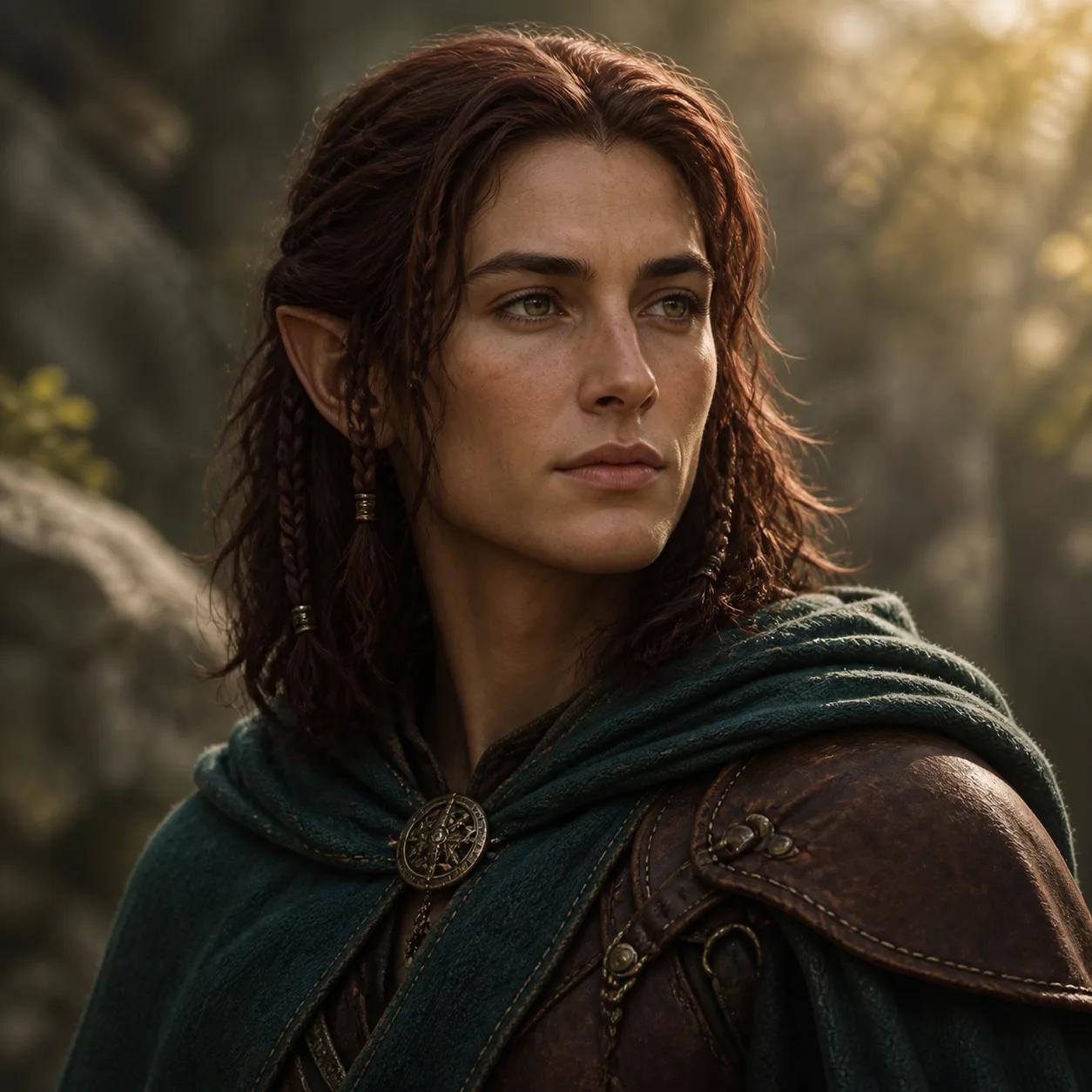
- Choose a specific face, age range, and expression before adding ancestry decoration.
- Select two or three visible cues—such as ear shape, hair framing, or facial structure—and keep the rest individual.
- Describe the character’s present role and temperament instead of relying on “mixed” as the entire concept.
Define the face and expression before the costume
Facial structure is the strongest anchor for a small character portrait. Choose a face that can be described in a few concrete terms: broad-cheeked, long and angular, soft-jawed, weathered, youthful, square, or gently asymmetrical. Add one memorable feature such as a freckle pattern, crooked nose, split eyebrow, faint scar, dimple, or unusual eye color. One clear feature gives the viewer a person to remember; a long list of minor marks usually disappears when the image is reduced.
Expression should show a current state rather than a permanent ancestry label. A Half-Elf can look watchful, amused, tired, patient, skeptical, welcoming, or quietly determined. Match the expression to the moment you want the portrait to represent: a guide waiting at a crossroads, a diplomat listening to a difficult request, a ranger checking the weather, or a scholar protecting a family letter. The eyes and mouth should remain unobstructed so the emotional cue survives beside hair and clothing.
Use light to separate the face from the background before you add atmosphere. A soft side light can reveal the brow, nose, cheek, and jaw while a cooler fill preserves the ear outline on the shadowed side. Keep magical glow, sunbeams, smoke, and scenic contrast subordinate to the eyes. If the face becomes hard to read, reduce the background or costume contrast instead of adding more effects.
Face-first check
Temporarily remove the ears, cloak, and role object from the description. If the remaining face and expression still identify a distinct person, the portrait has a strong anchor.
Use ear shape and hair to frame the identity
The ears are an efficient ancestry cue, but they should remain part of the head rather than looking pasted onto it. Decide their length, angle, and visibility in relation to the face. They can be short and sharply angled, longer and gently tapered, partly hidden by a side sweep, or visible on one side because the character turns three-quarters toward the viewer. Describe the outline first, then decide whether an earring, notch, or small mark adds personal history. No single ear shape is required for every setting or character.
Hair determines both silhouette and how much of the ears the viewer sees. Pick one dominant structure: loose shoulder-length waves, tied-back curls, a practical undercut, a single braid, a cropped style, or a swept fringe. Then add one restrained texture or accessory. A cord, bead, ribbon, clasp, or inherited pin can point toward a relationship or place without covering the eyes. Keep the hairstyle coherent with the character’s work and climate rather than using “ethereal” detail as a substitute for a design decision.
Check the hair, ears, and face together at the size where the portrait will be used. Thick strands can erase the ear angle; dark hair can merge with a dark cloak; and a large ornament can pull the eye away from the expression. Leave negative space around the eyes and one ear edge. If both ears disappear, strengthen only the most useful outline rather than adding extra jewelry and decoration.
- Set ear length, angle, and visibility in relation to the face and camera turn.
- Choose one dominant hairstyle before adding color, texture, or an accessory.
- Keep the eyes, mouth, and at least one ear outline clear in the square crop.
Show mixed cultural cues through clothing and materials
Clothing can suggest where a Half-Elf has lived, worked, or chosen to belong without turning culture into a costume label. Combine practical pieces with one meaningful variation: a travel cloak over a neatly cut collar, a human-style work apron fastened with an elven-inspired clasp, a formal jacket repaired with a family stitch, or layered fabrics from two places that still form one coherent silhouette. These are design options for an original character, not universal signs that belong to every community.
Use two or three material families so the clothing remains legible. Heavy wool, matte leather, brushed metal, linen, carved wood, or embroidered cloth each create a different response to light. Let one material dominate the shoulders and use another near the face or role object. Condition matters as much as type: a carefully mended seam, sun-faded edge, polished clasp, or rain-darkened collar can show routine and history with less visual noise than a fully decorated outfit.
Color can connect the character’s different influences without making the palette symbolic by default. Choose one stable neutral and one restrained accent near the face, clasp, scarf, or object. Deep teal with worn brown, cream with muted bronze, or slate with a faded red thread can distinguish the individual while keeping the image grounded. Explain the color as personal preference, family memory, workplace, or travel history when that matters; do not imply that one color represents all Half-Elves.
- Build one silhouette first, then add a single clothing detail that points to a place, relationship, or routine.
- Limit materials to two or three surfaces with distinct texture, condition, and light response.
- Use one neutral and one controlled accent so cultural or personal cues support the face.
Give the role one object and the person one anchor
A role becomes readable when one object, posture, or clothing choice explains what the character does. A bow and weathered cloak can support a ranger; a ledger or key can support an official; a staff, book, or small focus can support a scholar; and a hammer, blade, or shield edge can support a defender. The object does not need to fill the frame. Its location, condition, and relationship to the hands or shoulders should make it feel owned and useful.
Add one separate personal anchor that is not simply the class prop repeated. This can be a repaired family clasp, a ribbon from a former home, an unusual ring, a faded stitch, a map case, or a keepsake held near the chest. Place it where the upper-body crop can show it without crossing the eyes or mouth. If the role object and personal anchor compete, choose the one the table should remember first and turn the other into a quiet supporting detail.
Posture connects both objects to the character. A Half-Elf courier may angle one shoulder around a satchel; a diplomat may keep an open chest and steady hands; a ranger may turn toward a distant sound; a craftsperson may examine a repaired tool. Use one gesture, not a full action scene. A clean path from silhouette to face to object gives the viewer a quick understanding of identity, role, and mood.
One-object test
Ask what the viewer should remember after one glance. Keep the object that best connects the Half-Elf to a role or relationship, then remove inventory that only repeats the same idea.
Turn the appearance plan into a focused portrait brief
Write the brief in a stable order: individual identity, Half-Elf ancestry, face and expression, ear visibility, hairstyle, role, clothing silhouette, two or three materials, one role object, one personal or cultural cue, light, quiet background, and upper-body square crop. Put each choice into the matching field in the D&D Half-Elf portrait generator instead of writing an entire biography. The image needs visible decisions that can survive the frame, not hidden lore that the camera cannot show.
Review the first result by category. If the character looks like a generic Elf, make the facial structure more specific and reduce decorative cues. If the Half-Elf ancestry is unclear, adjust the ear outline or hair framing without covering the face. If the outfit feels like two unrelated costumes, simplify the materials and choose one shared color or fastening detail. If the role is missing, clarify one object and the posture that supports it before adding more equipment.
Revise one category at a time and preserve the anchors that already work. Keep the face while testing a different hairstyle, keep the ears while changing the cloak, or keep the personal clasp while changing the role object. NanoEditor creates one image per generation, so a controlled revision makes the comparison clearer. One successful guest generation is shared across the site; Google signup grants 20 credits, each portrait costs 10 credits, failed generations do not consume the allowance, and account results are private by default.
- First pass: face, expression, ears, hair, silhouette, role object, personal cue, light, and crop.
- Review: facial readability, ear visibility, hair separation, material hierarchy, object purpose, and background noise.
- Revision: change one weak category while preserving the strongest face, gesture, and personal anchor.
- Scope check: keep the result to one upper-body square portrait, not a character sheet, rules build, token set, or party scene.
Put the guide into practice
Create a D&D Half-Elf portrait
Start with Half-Elf preselected, then turn face shape, ear visibility, hair, clothing, role, and mood into one focused upper-body portrait.
Start creating